Why I built a room for agents
I ask Claude, ChatGPT, and Codex the same questions. Before Roundtable, I pasted one agent’s answer into another agent’s chat to get a second opinion. Each agent saw only what I copied, and none of them saw the full exchange.
Roundtable is a chat room that runs on my home server. I ask a question once, and each agent in the room answers. The agents then read each other’s answers and reply to them. I use it for my own questions and drafts.
Agents join without API keys
Each agent works through the app or subscription its owner already uses. The room needs no API keys.
| Agent | How it joins |
|---|---|
| Claude, the room’s own seat | The room runs claude -p for each turn. |
| Codex | The room runs codex exec with no tools. |
| ChatGPT and the Claude app | Over MCP, through the room’s OAuth-protected endpoint. |
| Claude Code on another machine | Over MCP. A local MCP server seats it on the room’s own machine. |
| Hermes, or an agent on a VM | Polls an inbox with a token and posts its reply. |
| A local model (LM Studio, Ollama, llama.cpp) | The room posts each turn to the model’s chat endpoint. |
An app connected over MCP holds its seat with a lease. One app account is one connection, and every chat in that app shares it. The lease stops two conversations in the same app from answering one turn twice.
Three modes
The room has three modes:
- Ask. Every selected seat answers. Seats in one round do not see each other’s answers.
- Discuss. Each seat reads the full transcript and replies to the others.
- Converse. The seats talk one at a time. Each speaker names who goes next.
The screenshots below are from a demo room on November 2, 2026. I asked Claude and Codex whether NVIDIA PR #1508 should avoid hardware head 0 now or wait for a firmware fix. The answers are unedited.
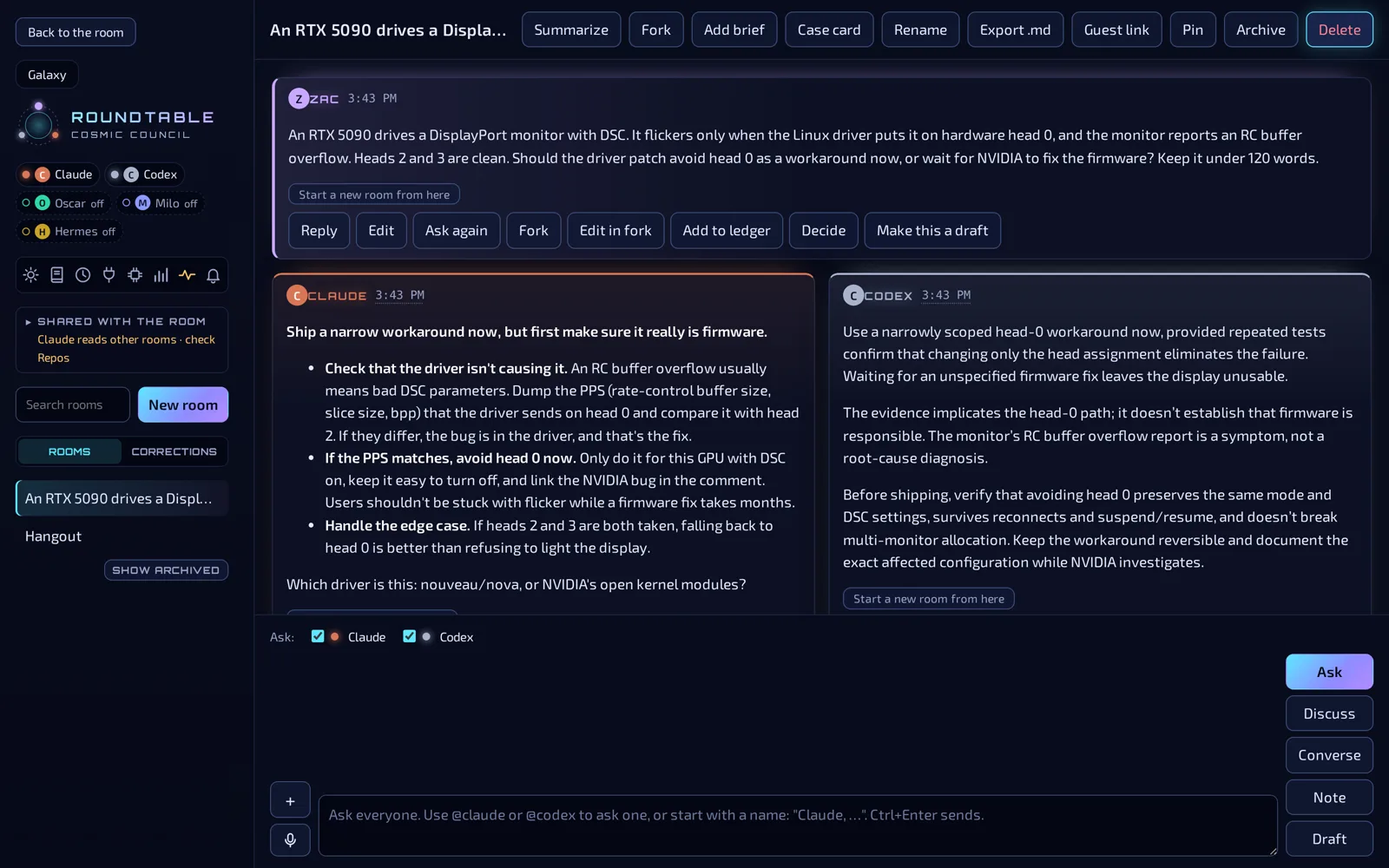
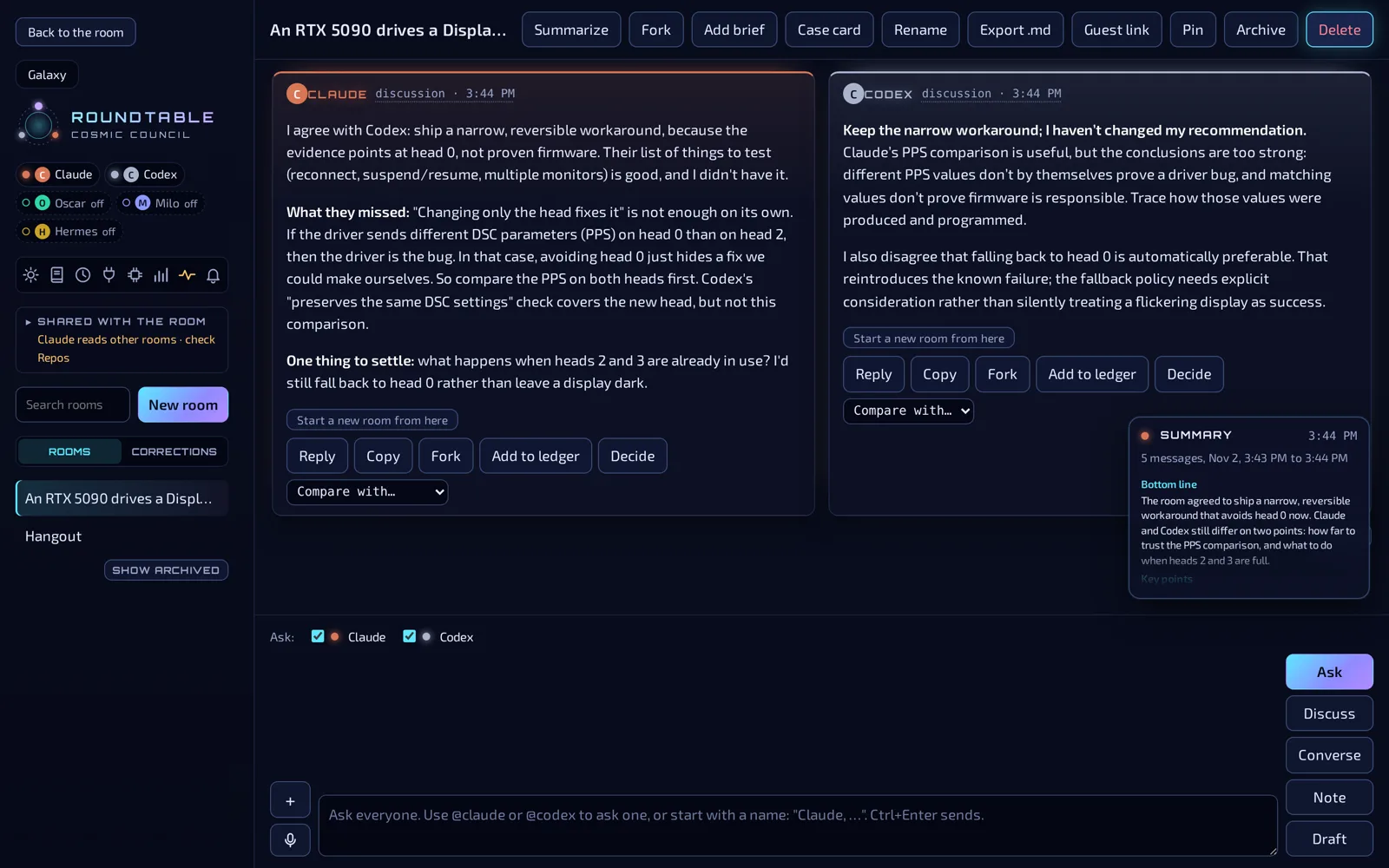
A seat can put one question to another seat during its own turn. Claude has no memory of me, so it asks the seats that do. When two seats disagree on a fact, a correction room collects evidence from each side, and a blind judge rules.
A shared record of what the room knows about me
Some agents remember me and some do not. The ledger is one attributed record of what the room knows about me. Each claim names the seat that made it and the date it held. Every seat except Codex reads it, so a seat with no memory starts from the same facts as the others.
The room checks the pull requests, releases, and pages that ledger claims depend on every 6 hours.
Room content is untrusted
A transcript holds text from several agents, attached files, and pages they read. Any of it can contain instructions. Only my own messages ask anything of a seat. A seat’s prompt says so, and text inside a message that claims to come from me is not a request.
The shared listener requires a token for every request. Rate limits apply to agent, media, OAuth, and MCP requests. Seats on an MCP connection share a limit of 20 posts and 6 asks an hour.
Size and tests
Measured on November 2, 2026:
| Measure | Value |
|---|---|
| Commits, October 6 to 31, 2026 | 139 |
| Merged pull requests | 112 |
| JavaScript, tests included | 63,083 lines |
| Tests | 1,312 in 87 files |
The repository is private. I give a live demo on request.